
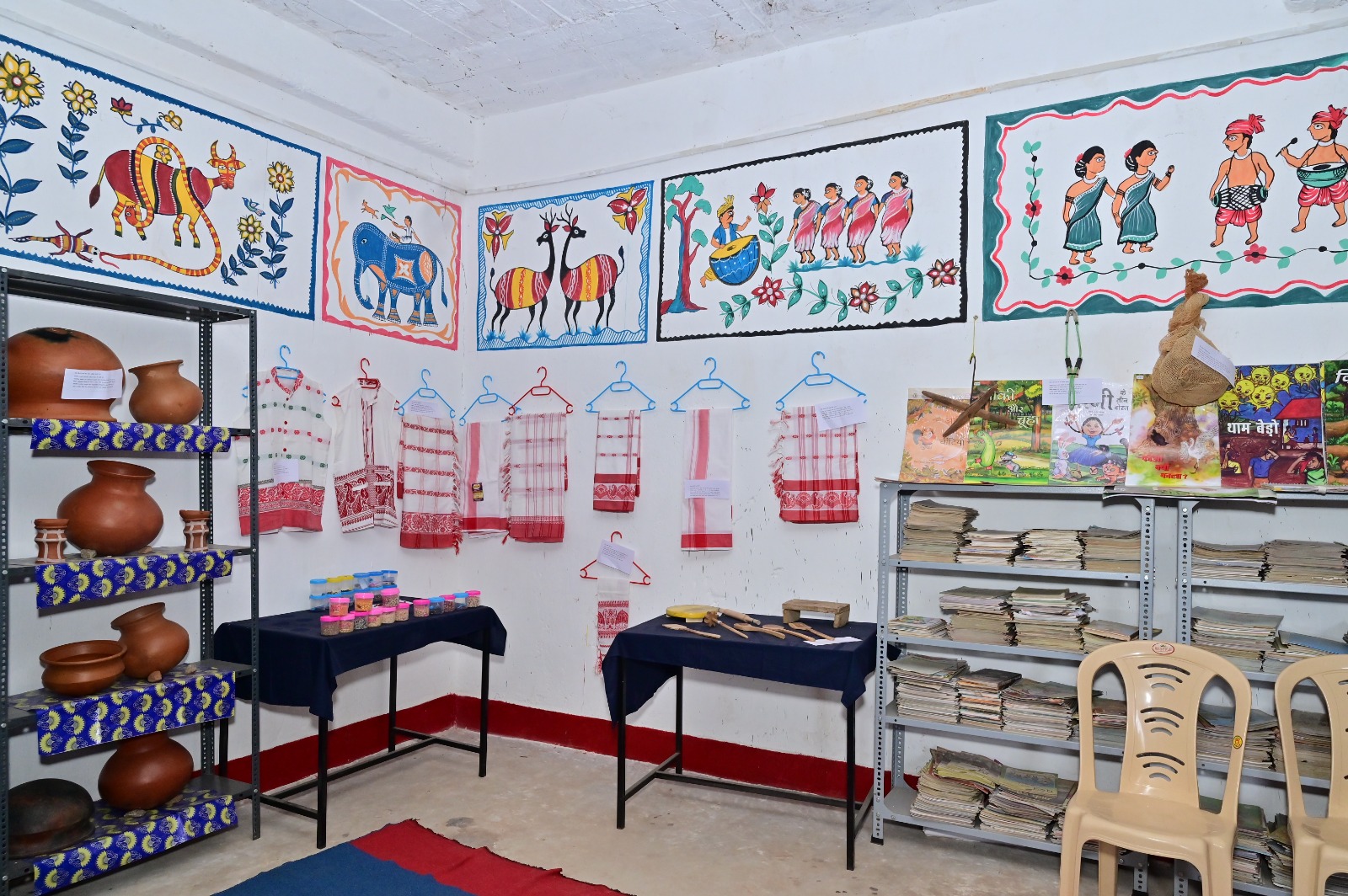
Over four months, that dream slowly took shape through meetings, ideas, contributions, and people coming together. And what emerged at Middle School Kachhupani in Simdega, Jharkhand, under the *PALASH Multilingual Education Programme, became much more than a school museum and library. It became a space where children could see themselves and their world reflected in learning — through their language, culture, and stories.
What makes this journey meaningful is not just what was built, but how it was built. It grew through the collective efforts of the school, community, government, and Language and Learning Foundation (LLF), with local participation and shared ownership guiding every step.
The journey began in January with a two-day workshop for Multilingual Education (MLE) teachers from schools across Simdega district. Supported by the government and facilitated by subject experts from Chhattisgarh, the sessions explored how school museums and libraries can become living learning spaces — not places children simply pass through, but spaces they connect with, engage with, and learn from every day. Teachers also explored ways to build, document, and meaningfully bring these spaces into classrooms.
As discussions continued with the School Management Committee and the Gram Sabha, the vision became stronger and more rooted. Local ideas shaped decisions, ensuring the initiative reflected the community around it rather than being built for it.
Soon, the community itself became part of the story. Families and village elders contributed traditional objects and cultural artifacts — not merely as exhibits, but as memories, stories, and pieces of identity. Through village visits and conversations, children found new ways to connect with their language and culture, making learning feel more personal and familiar.
LLF supported the selection and procurement of age-appropriate multilingual books and provided continuous academic and technical support throughout the journey. Because the goal was never just to create shelves of books or displays of artifacts. It was to build a space that sparks curiosity, invites conversations, and helps children feel a sense of belonging.
When government officials, members of the Jharkhand state team, school representatives, teachers, students, and community members finally gathered for the inauguration, it felt like a community seeing its stories, language, and memories find a home inside a school. And perhaps that was the most meaningful outcome of all, children walking into a space and finding pieces of their own world waiting for them there.
* The PALASH Multilingual Education (MLE) Programme is a flagship initiative launched by the Jharkhand Education Project Council (JEPC) in collaboration with UNICEF and the Language and Learning Foundation (LLF). It aims to improve foundational learning for tribal children by initially teaching them in their native mother tongues.
#EducationForAll #Libraries #GovernmentSchools #Museums #CommunityImpact