Blogs

Blogs2023-06-11T07:14:29-07:00

My experiences at the Summer Camp

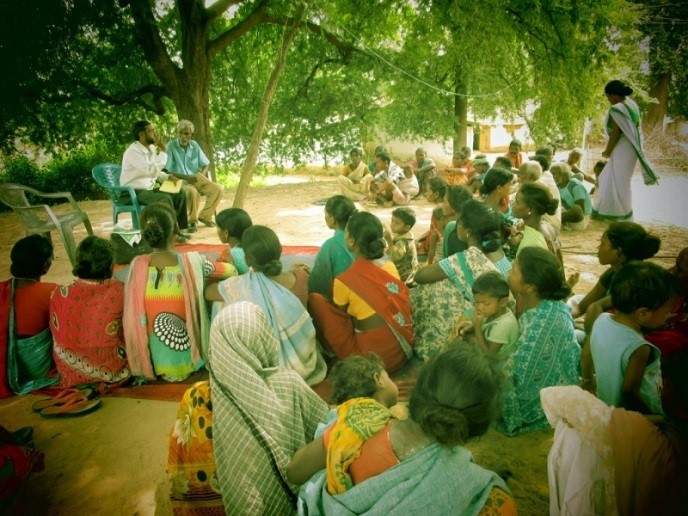
On the first day, we came and we needed to set up many things such as the computer, projector etc. After setting these up, batch-by-batch the children started coming, so we needed to set them in straight lines and make them sit in a row. We anticipated that there will be more Tamil than Oriya students, and we will be able to communicate easily. But, out of a 100 students, only 7 were Tamil, the rest 93 were Oriya or Hindi! This was a problem as we couldn’t communicate easily, but Bitika Aunty, talked to each of the children in Oriya and asked their names. For the first session of the morning we had nursery rhymes for all of the children. For example; Roly Poly, Skeleton Dance.

Books not bricks

These young migrant children wandered around the brick kilns, and were being exposed to serious safety hazards. Slowly, yet surely they were also being forced into child labor in the brick kilns. Tamil Nadu is a land of 3,000 brick kilns where 90% of the 300,000 workers are seasonal migrants from within and outside the state.

Schools as Multi-Dimensional Learning Space – Need

While the need to improve quality of education at Government Schools seems intuitive, I still think it would be good to see some numbers to make the point. Intuition can sometimes be inaccurate and looking at the right statistics and figures numbers are important to ascertain intuitions. As you read this, you will come to realize (if you haven’t already), the magnitude of the problem and the underlying issues that I feel are the core reasons why on quality of education is important.

Schools as Multi-Dimensional Learning Space – Genesis

I am pretty excited to start this series of blogs on one of the most interesting projects of my life. This is a project that focusses on improving quality of learning in Government schools especially in rural India. The goal of this project is to create a model that is replicable, holistic, low cost and easy to implement. Through these articles, I will articulate what we attempted to do, our collective learning and my own experiences. While the blogs are being written by me, I am documenting our collective learnings as a team. The success of the project is because of the team working behind it and not one person. Personally, its been a enriching experience to work along with such a dedicated and passionate team.

2016 Events

  • An Evening for Literacy – ILP Annual Dinner, Oct 15,2016
  • ILP Partners Meet Aug 3-5, 2016
    • India Literacy Project’s Annual Partners Meet is being held in Bangalore, India between Aug 3rd and Aug 5th, 2016. The event is a great platform for all

Anything is possible

When we entered the class of 60, which consisted of 6th, 7th and 8th graders, we were a bundle of nerves. All of us were volunteering from ILP to help SSA and IRCDS conduct a summer camp for the children of brick kiln workers. The main aim of the camp was to motivate children from various age groups to continue schooling as well give them a reason on why education is so vital for all of us.

2015 Events

  • An Evening for Education – ILP Chennai Dinner, Nov 21, 2015
    • Join us to celebrate “An Evening for Education” at India Literacy Project’s Chennai Chapter first ever dinner on Nov 21st 2015. Network with other patrons, listen to accomplished speakers and hear about ILP’s programs that are transforming the lives of many people. With your support we can create a greater impact.
  • An Evening for Literacy

The Excesses of Helping Out Mom and Dad

The headlines read, “Construction booms as India heads towards a Global Industrial Giant Status.” But behind this construction is the pitiful plight of the back breaking labor of thousands of brick kiln workers and their children. By its very nature, work in brick kilns is seasonal, – December through August, and 90% of its labor pool are migrant workers from neighboring areas (source districts). Workers pledge their labor and get an advance of Rs. 45,000-70,000 from middlemen, at the time of employment. Brick kiln workers usually stay inside their work places for the entire season (7-8 months) and work around 12-14 hours per day, including 7 hours of nighttime work. Bonded labor is not uncommon in this line of work.

2014 Events

  • ILP Annual Dinner – Oct 11th, 2014
  • ILP Youth – Talent Show – Sep 20th, 2014
  • ILP Youth – Photo Contest – Aug -Jan 2015
  • Evening of Entertainment – Tamil Comedy Drama with Y.G. Mahendra, June 7th 2014
  • Race For Literacy – May 18th,

A Visit to Schools in Jharkhand Villages

Are we trying to solve a problem with another problem? So it appeared to me when I recently visited schools in some of the remote Jharkhand villages with a group of India Literacy Project (ILP) volunteers. As we drove past extensive paddy fields, we enjoyed the lush green landscapes and monsoon rains. On the first day, we stopped by six villages in Lohardaga along with our partner NGO LGSS, led by Mr. C. P. Yadav and his staff. The entire NGO team is highly committed to improving the education scene in the Kairo block of Lohardaga district.

Learning to learn values

For quite a few months, I have been dwelling on this thought on how to teach values to children (through ILP’s MDLS program we work a lot with High school children and hence that was the focus area). No, I am not an epitome of good values which gives me the right to teach someone values (by the way, no one is an epitome of values and nobody should teach values and I will come to that in a bit), but I couldn’t think of an alternate word for it back when I was thinking about it. I knew values were not about good or bad or right or wrong and I had my own perspective on it, but somehow, it was neither topic enough to engage children nor was it a universal thought… it was just my take on life.

This is no ordinary 71%

Second PU results came out last week. One of the girls, Pragati , supported by ILP scored 71%. Everyone at ILP was extremely happy at the achievement. Even NDTV came over to cover her as part of their series on education. Surprised? And wondering why a girl, who scored 71% marks, became this significant, when the first rank student in Karnataka probably scored 98% or more.

Go to Top