A Trip to Educate and Get Educated
A visit report by ILP Volunteer, Divya Chinnappa
ILP volunteer Divya Channappa visited ILP projects this summer. Watch a video about her eye opening experience during her visit and read about it in this article.
A visit report by ILP Volunteer, Divya Chinnappa
ILP volunteer Divya Channappa visited ILP projects this summer. Watch a video about her eye opening experience during her visit and read about it in this article.
By Suchitra Rao
ILP joined forces with four other NGO’s to facilitate children’s involvement in providing suggestions for Karnataka state government's new act on child safety at schools. The suggestions included a zero tolerance policy against bullying and sexual abuse, placement of suggestion boxes for children to put forth proposals under anonymity, and involvement of senior students in Children Protection Committees. ILP is committed in generating awareness amongst children regarding their rights and responsibilities; they are not citizens of tomorrow but are very much the citizens of today and their issues should have an active representation in the agenda of all policymakers.
By Malini Nagarajan
This May, ILP continued it’s two decade long association with the Golden Gate Relay.The event which is organized by Organs R Us for promoting the noble cause of organ donation, provides ILP a major platform for fundraising where we strive to raise around 250K USD every year. ILP is grateful to have an army of passionate volunteers who block out their weekends to train and participate for the relay, and undertake the management of logistics involved in making this event a success.
By Subhash Pochareddy
ILP drives a wide array of efforts to enable children’s education from preschool to high school and beyond. In an effort to quantify our efforts ILP has designed Key Performance Indicators (KPIs) that provide objective and real-time view of progress to us, and to our NGO partners. These KPIs help ILP to objectively evaluate the impact that we are making to improve the schooling, learning outcomes, and to provide career guidance and more.
It was the year 1989 and we had an impressive visitor from India. The handout for his talk, spoke about the need for action. The speaker was none other than Dr. Parameshwara Rao. Dr. Rao had a simple yet powerful message. He said – if we don’t do anything, by year 2000, every second illiterate in the world will be an Indian! This stirred up a bunch of us and we felt something needed to be done. This led to the formation of ILP in 1990, registered as a non-profit in Chicago, United States. As a first step, we decided to support Dr. Rao’s own organization BCT. Supporting BCT, gave ILP the right background and experience to support many literacy and education projects across India.
If you chronicle a successful family unit of any ethnicity or geography, you will often find that a woman has played a pivotal role. Sometimes the role is overt and obvious for all to see and appreciate. But often times, the contribution is behind the scenes, forming the bedrock upon which the family thrives.
Most of my earlier trips to India were to the biggest cities – Bangalore, Delhi etc. They were full of crowds, dust and traffic. It was my normal image of India: a poor, dirty, crowded, and very competitive place. A place where dogs and other animals roamed the streets starving, begging for food and where people sat in slums with rags on them. At least that’s what I first thought. This was my first journey into India’s villages and until now I had only seen photos and videos of what it was like. This time I was the one taking the pictures and videos as I experienced it myself, and I loved all of it!
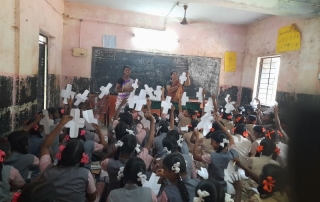
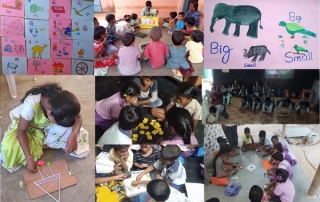
On the first day, we came and we needed to set up many things such as the computer, projector etc. After setting these up, batch-by-batch the children started coming, so we needed to set them in straight lines and make them sit in a row. We anticipated that there will be more Tamil than Oriya students, and we will be able to communicate easily. But, out of a 100 students, only 7 were Tamil, the rest 93 were Oriya or Hindi! This was a problem as we couldn’t communicate easily, but Bitika Aunty, talked to each of the children in Oriya and asked their names. For the first session of the morning we had nursery rhymes for all of the children. For example; Roly Poly, Skeleton Dance.
While the need to improve quality of education at Government Schools seems intuitive, I still think it would be good to see some numbers to make the point. Intuition can sometimes be inaccurate and looking at the right statistics and figures numbers are important to ascertain intuitions. As you read this, you will come to realize (if you haven’t already), the magnitude of the problem and the underlying issues that I feel are the core reasons why on quality of education is important.
I am pretty excited to start this series of blogs on one of the most interesting projects of my life. This is a project that focusses on improving quality of learning in Government schools especially in rural India. The goal of this project is to create a model that is replicable, holistic, low cost and easy to implement. Through these articles, I will articulate what we attempted to do, our collective learning and my own experiences. While the blogs are being written by me, I am documenting our collective learnings as a team. The success of the project is because of the team working behind it and not one person. Personally, its been a enriching experience to work along with such a dedicated and passionate team.