
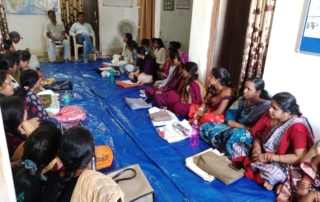
When Vidya Saathis start with the child, not the syllabus
Across 40 village learning centres in Odisha, children begin their day with a small but important step, showing up to learn.
Most come from nearby hamlets, often with gaps in their foundational skills. Some struggle to read simple text in Odia, others find basic math difficult. Before they can keep up with their grade-level curriculum, they need a chance to catch up.
This is where the Vidya Saathis come in.
Each Vidya Saathi works closely with a group of 20–35 children, following a simple, structured plan. 70 hours of focused learning spread over 12 weeks. Instead of rushing ahead, they start where the
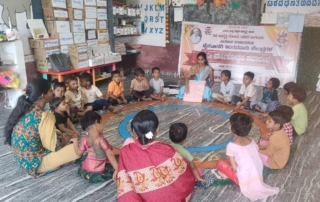
What happened when a village decided to invest ₹22 lakh in its children
In Bairawadgi village in Karnataka, an Anganwadi has quietly come a long way.
Not long ago, it ran out of a rented space, with just 7–8 children attending. For many families, it didn’t feel like something they needed to prioritise. Awareness was low, and the centre was simply there—but not fully valued.
The change didn’t come overnight. It started with small, steady steps.
Through Pre-School Education (PSE) training, the Anganwadi teachers started bringing more intention into everyday activities—understanding how children learn, not just what to teach. At the same time, regular meetings with parents and the community opened up conversations around early childhood
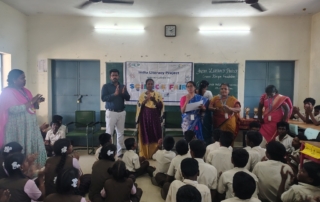
Here’s how 39 students found the courage to try science experiments for the first time…
At Ekalavya Model Residential School in Tamil Nadu, where many students come from tribal communities with limited academic exposure, a simple but important question emerged—how do we create an opportunity where they can explore science and feel confident enough to present it on their own?
Three teachers: Rajalakshmi, Nandhini, and Sowndharya chose to move forward with belief.
Over three days, they worked closely with the students breaking down concepts, guiding them through simple experiments, and building confidence step by step. The physics lab gradually came alive not just with materials, but with curiosity, effort, and a quiet sense of excitement.
There were moments
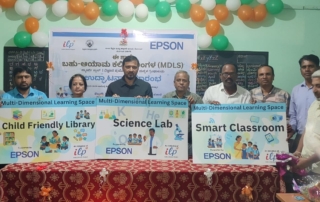
Multi-Dimensional Learning Spaces: Making Learning Visible, Accessible, and Experiential
With support from Epson, ILP has been shaping classrooms across Kolar and Tumakuru through Multi-Dimensional Learning Spaces (MDLS) in 100 schools as part of the 2025–26 cycle of the programme where learning moves beyond the textbooks and is designed to help children explore, experiment, and learn more effectively.
This builds on a long-standing partnership with Epson since 2017, which has now reached 532 schools and over 55,000 students.
Smart classrooms: NCERT-aligned, open-source visual content (Grades 4–10) supported by teacher training.
Child-friendly libraries: Curated multilingual books, structured library processes, and reading-level-based access through Hippocampus GROWBY methodology, whereby books
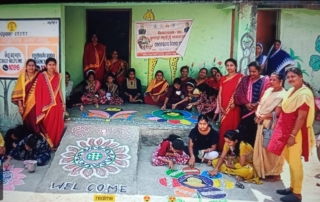
Kishori Melas – Creating safe spaces for girls to ask, learn and understand
Mukhyamantri Sampoorna Pushti Yojana, an Odisha state government initiative, is designed to improve nutrition among women, children, and adolescent girls.
But real change doesn’t come from policy alone; it takes a community to turn intent into action.
That’s where the 𝗣𝗮𝗻𝗰𝗵𝗮𝘆𝗮𝘁-𝗹𝗲𝘃𝗲𝗹 𝗞𝗶𝘀𝗵𝗼𝗿𝗶 𝗠𝗲𝗹𝗮 comes in.
Here, adolescent girls step into a space that feels safe, open, and their own; not as beneficiaries, but as active participants in their well-being.
They ask questions they’ve held back out of fear and hesitation about health, nutrition, and their changing bodies. And for many, it’s the first time they truly understand their biological system.
Haemoglobin levels are checked. Iron
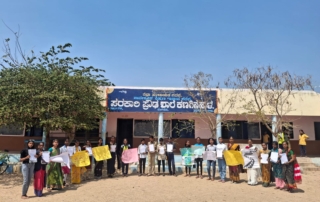
When Career Guidance comes from school alumni
At Government High School Kanganur, Belgavi, Karnataka the most powerful lesson of the day didn’t come from a textbook. It came from seeing what’s possible when the students who once sat on these very benches returned as professionals.
ILP helped the school host a Career Mela that felt less like an event and more like a homecoming. Familiar faces carried stories of journeys taken, skills built, and choices made beyond the school gates.
Students moved from stall to stall, not just collecting information but engaging in real conversations.
They stood beside goats to understand animal husbandry, listened to a farmer break down the
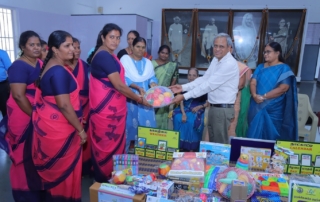
Strengthening Anganwadi centres in Tamil Nadu with TLM Kits
For many children, the Anganwadi centre is their first introduction to structured learning. Strengthening these centres plays an important role in helping children transition confidently into school and sustain their learning journey.
To support this early foundation, ILP is providing 𝗧𝗲𝗮𝗰𝗵𝗶𝗻𝗴 𝗟𝗲𝗮𝗿𝗻𝗶𝗻𝗴 𝗠𝗮𝘁𝗲𝗿𝗶𝗮𝗹 (𝗧𝗟𝗠) 𝗸𝗶𝘁𝘀 𝘁𝗼 𝟱𝟬𝟬 𝗔𝗻𝗴𝗮𝗻𝘄𝗮𝗱𝗶 𝗰𝗲𝗻𝘁𝗲𝗿𝘀 𝗮𝗰𝗿𝗼𝘀𝘀 𝗳𝗶𝘃𝗲 𝗱𝗶𝘀𝘁𝗿𝗶𝗰𝘁𝘀 𝗶𝗻 𝗧𝗮𝗺𝗶𝗹 𝗡𝗮𝗱𝘂 in the first phase of the initiative. With support from the 𝗗𝗿𝘀 𝗥𝗮𝗺 & 𝗧𝗵𝗮𝗶𝗹𝗮 𝗥𝗮𝗺𝗮𝗻𝘂𝗷𝗮𝗺 𝗙𝗼𝘂𝗻𝗱𝗮𝘁𝗶𝗼𝗻, each centre is being equipped with a ₹25,000 learning kit to strengthen early childhood education.
Along with these resources, Anganwadi Workers and Helpers are being trained to
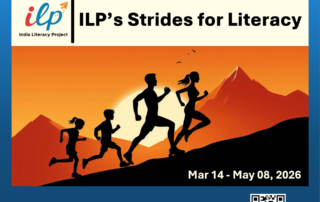
Join ILP’s Strides for Literacy, March 14 – May 8th, 2026
Achieve your fitness goals with every stride. Join ILP’s Strides For Literacy for a walk/run 100/200/400 miles over 8 weeks, where you walk and run with your friends or on your own and accumulate miles and, supporting the education of thousands of children in India. ILP’s Strides For Literacy on March 14th – May 8th, 2026.

ILP Beats on June 8th 2025 @ Jersey City, NJ
Join for ILP Beats a musical night for education on June 8th 2025 between 5-9pm at Jersey City, New Jersey. More details coming soon! Stay tuned!
Join ILP’s Strides for Literacy, March 21 – May 16, 2025
Achieve your fitness goals with every stride. Join ILP’s Strides For Literacy for a walk/run 100 or 200 miles over 8 weeks, where you walk and run with your friends or on your own and accumulate miles and, supporting the education of thousands of children in India. ILP’s Strides For Literacy on March 21-May 16, 2025.
ILP Virtual Dinner , Sep 26 2021
Join us for “An Evening for Education” on Sunday, Sep 26, 2021 4PM PT, online.
Team ILP @ The Relay, May 2-3, 2020
Join our runners and walkers in the 30 hour relay on May 2-3, 2020.