
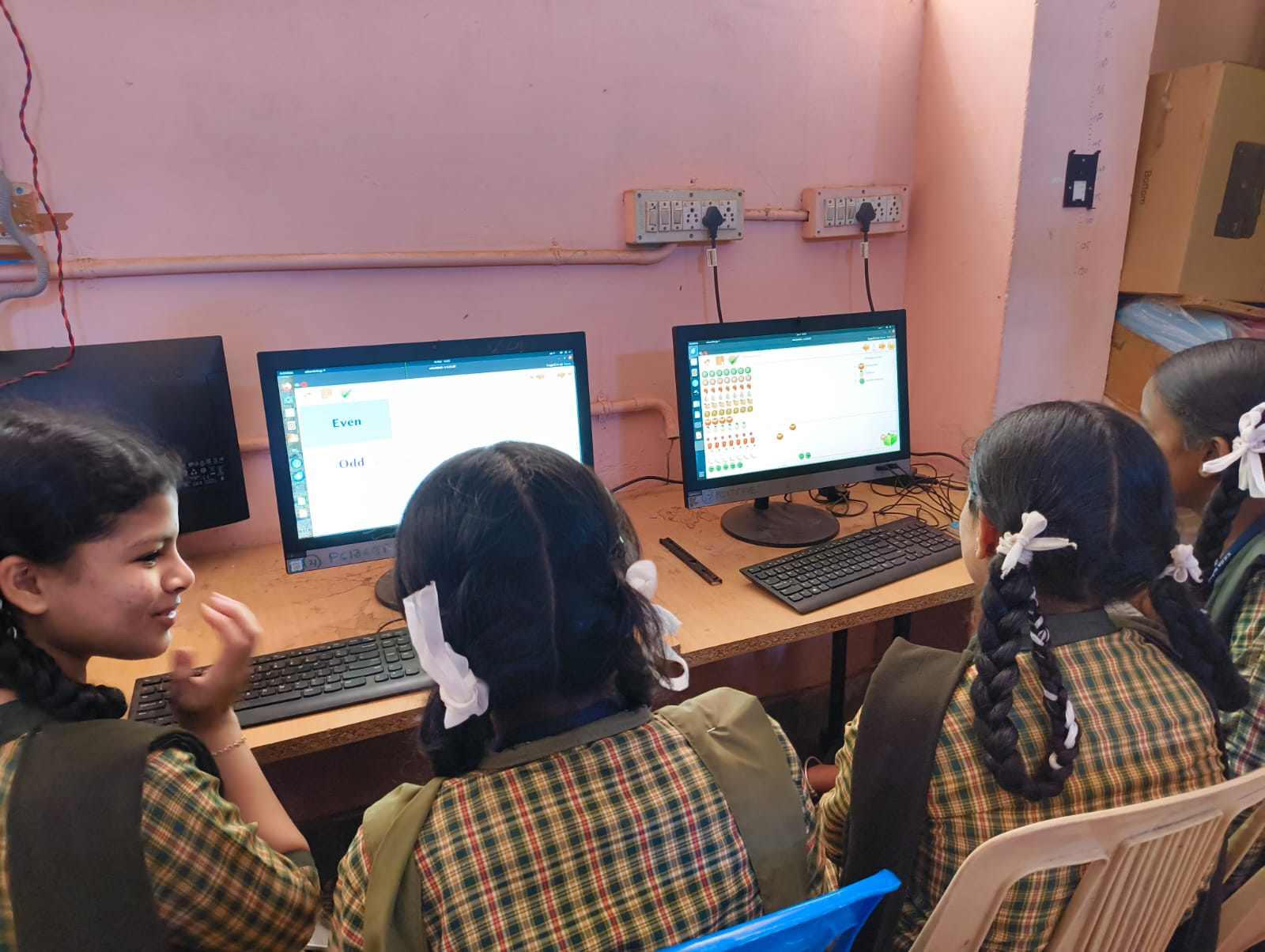
During a visit to a government high school in Karnataka, an ILP ICT Facilitator noticed Sharanya (name changed), a Child With Special Needs (CWSN) who rarely participated in classroom activities. Her teachers, too, observed that she remained largely disengaged.
ILP’s ICT Facilitator decided to try a different approach. He introduced her to drawing and painting on Ubuntu and gradually moved to basic Mathematics through pictorial activities on the computer.
The change was remarkable.
Sharanya began grasping mathematical concepts quickly. She showed a keen interest in the activities, solved calculations faster and became more actively involved in classroom sessions.
Her progress was reflected in her academics too with a significant improvement in Mathematics and English in her assessments.
Even her teachers noticed the transformation and shared how the digital literacy sessions had brought about a visible change in her.
ILP’s digital curriculum brings together subjects such as Mathematics, Science, English and Social Science through interactive applications, simulations and educational games. From solving mathematical problems and exploring scientific concepts to developing language skills, these tools make classroom learning more engaging while building logical thinking, creativity and problem-solving abilities.
Sharanya’s journey through ILP’s digital literacy initiative offers an important reminder: Inclusive education is not just about bringing every child into the classroom. It is about recognising that every child has different abilities and finding ways to help each one realise their potential.
If you want to open up new possibilities for children across government schools reach out to us by mailing: archana@ilpnet.org
#DigitalLiteracy #DigitalLearning #EducationForAll #GovernmentSchools #ChildCentredLearning